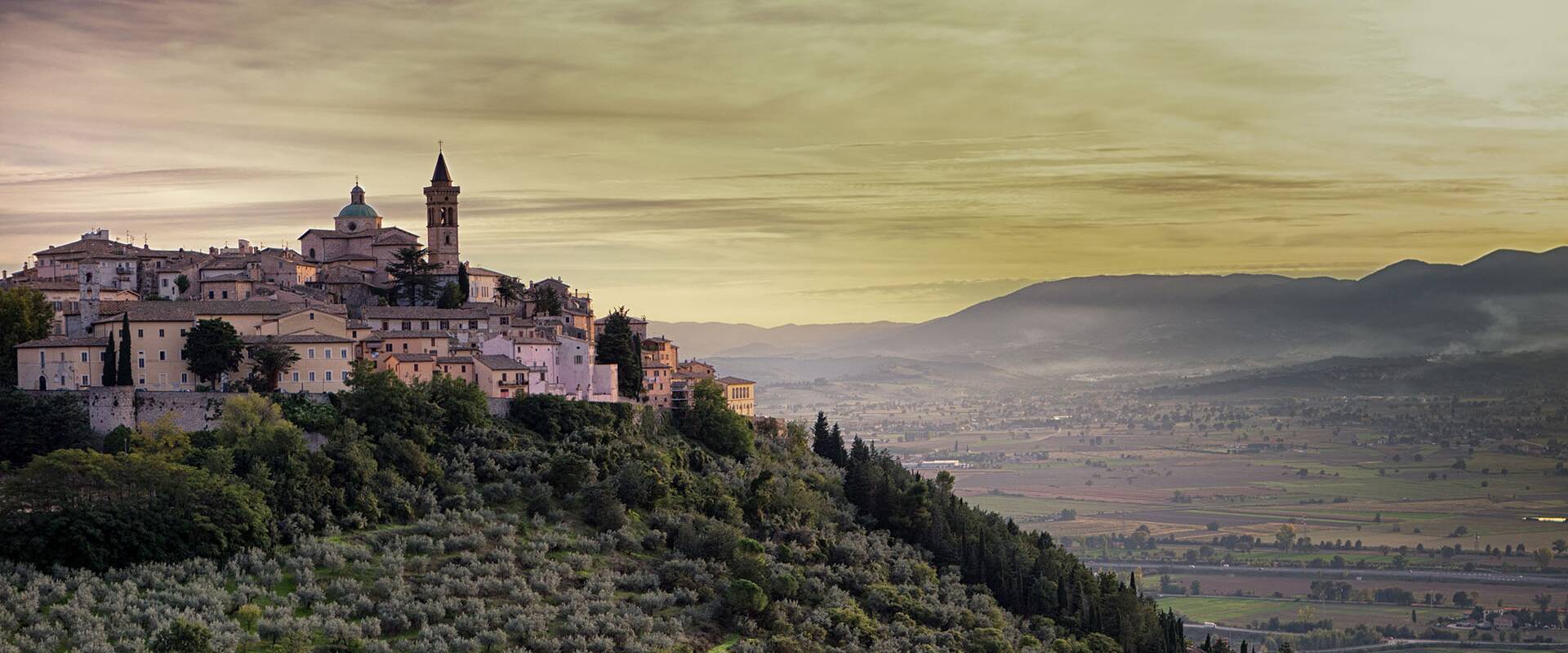
One of the quiet privileges of staying in the Niccone Valley is what surrounds you. Within a short drive of Casa Luna — in every direction — lie some of the most remarkable medieval towns in all of central Italy. Not tourist reconstructions. Not sanitised theme-park versions of the past. Real towns with real histories, where people still live and work and argue over coffee in the piazza on Saturday morning. The cobblestones have been worn smooth by eight centuries of feet. The fortress walls still stand. And the views from the hilltops — across valleys that seem untouched by anything invented after the Renaissance — are the kind that stop you mid-sentence and make you want to stay a little longer than planned. Here are three of our favourites.
Umbertide: The Valley's Living Heart
Umbertide doesn't try to dazzle you. It doesn't need to. The largest town in the Niccone Valley and the closest to Casa Luna — just ten minutes by car — it has the easy confidence of a place that has been quietly going about its business since the early Middle Ages and sees no particular reason to change now. It is, in the best possible sense, a town for living in rather than looking at.
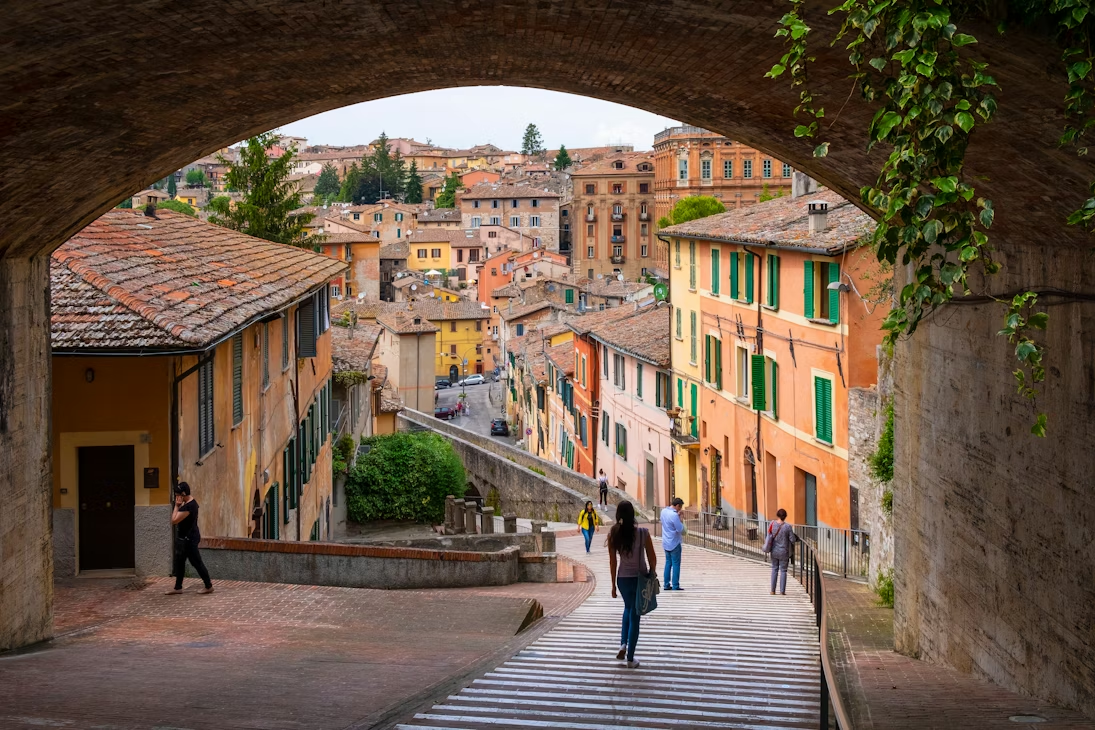 Umbertide from the surrounding hills — the circular Torre di Porta Vecchia rises above the medieval centre, a landmark visible for miles across the valley
The town's centrepiece is its remarkable circular fortress — the Rocca di Umbertide — built in the fourteenth century and one of the best-preserved examples of military architecture in the region. Today it houses a contemporary art museum that feels genuinely surprising in this setting, rotating exhibitions from Italian and international artists in rooms where archers once kept watch. The combination of medieval stone walls and modern canvases is more harmonious than it sounds — the fortress has a way of absorbing whatever is placed inside it.
The town's Saturday market is one of the best in the area. Farmers and producers from across the valley set up in the central piazza and along the surrounding streets, selling seasonal produce, cheeses, cured meats, fresh pasta, and the kind of bread that makes you wonder what you've been eating at home all your life. If you're spending a week at Casa Luna, organising your Saturday around the Umbertide market is not optional — it is the whole point of the morning.
The Church of Santa Maria della Reggia deserves at least a brief visit — a sixteenth-century octagonal building with an unusual centrally-planned interior that feels almost Byzantine in its geometry. It sits just outside the old centre and is often overlooked by visitors in a hurry for the fortress. Don't be in a hurry. Umbertide rewards the unhurried.
Distance from Casa Luna: 10 minutes · Best day: Saturday (market) · Don't miss: The Rocca fortress, the Saturday market, a coffee at one of the piazza bars · Practical note: Free parking available on the edge of the old centre; the main streets are mostly pedestrianised
For lunch, the streets around the central piazza have several trattorias serving straightforward Umbrian food at very reasonable prices — this is not a tourist economy, and the menus reflect that. Local pasta dishes, grilled meats, and in season, truffle shavings on nearly everything. A carafe of the house wine costs what a glass costs in most cities. The pace of lunch here, unhurried and generous, is the pace of the whole town.
Montone: Italy's Most Beautiful Village
The claim is official — Montone has been designated one of the Borghi più belli d'Italia, Italy's most beautiful villages, a distinction awarded to fewer than three hundred settlements in the entire country. Standing at the top of the town on a clear morning and looking out over the forested hills rolling away in every direction, you understand immediately why. Montone isn't just beautiful. It is the kind of beautiful that makes the word feel inadequate.
 Montone rises from its wooded hillside like something from an illuminated manuscript — one of fewer than 300 settlements to hold Italy's official designation as among the country's most beautiful villages
The town sits on a solitary hill about twenty minutes from Casa Luna, surrounded on all sides by forest and farming land. It has no bypass, no sprawl, no new development pressing against its medieval walls. What you approach is what has always been there: a tight cluster of pale stone buildings crowning a hill, encircled by ancient fortifications, with a single road winding up through the trees to the gate. From a distance, in the right light, it looks like a painting. Up close, it feels like one.
The streets of Montone are narrow and steep, paved in old stone, lined with houses that seem to grow directly out of the hill. There are no cars in the upper town — or rather, there is barely room for them — and the silence when you walk through the lanes is the particular silence of a place that has been quietly inhabited for eight hundred years. The Museo comunale holds a small but exceptional collection of medieval and Renaissance art, including a rare fragment of what is believed to be a piece of the Crown of Thorns, brought back from the Crusades by the town's most celebrated son, the condottiere Braccio Fortebraccio. The story of his life — soldier, statesman, briefly the most powerful man in central Italy — is the story of the town in miniature.
Montone hosts the Cavalcata di Calendimaggio in early May, a medieval pageant that fills the town with flag-throwers, drummers, and processions in fourteenth-century costume. If your visit coincides with it, rearrange your schedule. It is one of the most authentic traditional festivals in the region — not a performance for tourists, but a genuine act of communal memory that the town has been performing every May for centuries.
Distance from Casa Luna: 20 minutes · Best time: Morning, before day-trippers arrive from Perugia · Don't miss: The view from the top of the town, the Museo comunale, the walk along the old walls · Practical note: Park outside the gate — the interior streets are on foot only
The town has a handful of excellent restaurants and, in recent years, a small number of artisan shops selling locally made ceramics, olive oils, and wines. It is not a shopping destination in any conventional sense — the pleasure of Montone is simply being in it, walking slowly, looking up at the towers, sitting in the small piazza with something cold while the afternoon light changes the colour of the stones from gold to amber to rose. Plan for a half-day at minimum. It is very easy to spend a full one without noticing.
Cortona: Tuscany's Hilltop Masterpiece
Strictly speaking, Cortona is in Tuscany rather than Umbria — the regional border runs through the valley below its walls. But from Casa Luna it is barely thirty-five minutes, and its relationship with the Niccone Valley is so intimate, its cultural gravity so strong, that it would feel like a genuine omission not to include it here. Cortona is one of the great hilltop towns of central Italy, full stop. And it is close enough to make a half-day visit effortless.
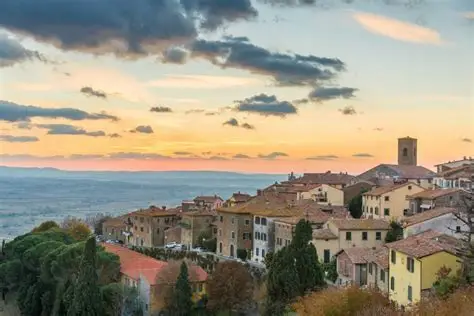 Cortona at sunset, the rooftops burning gold above the Val di Chiana — one of Tuscany's oldest and most magnificent hilltop cities, just 35 minutes from Casa Luna
The town's origins are Etruscan — older, in other words, than Rome itself. The cyclopean walls that still partly encircle the upper town date from this period, massive irregular stones fitted without mortar in a technique that has baffled engineers for centuries and outlasted everything built since. Walking along what remains of these walls on the upper edge of the town is one of the more quietly astonishing things you can do in this part of Italy — the view across the Val di Chiana is vast and still, and the stones beneath your hands feel genuinely ancient in a way that no museum exhibit ever quite manages.
The Museo Diocesano, housed in a former church beside the Duomo, contains one of the finest small art collections in Tuscany — Fra Angelico's Annunciation alone justifies the entrance fee, a work of such luminous gentleness that it stops most visitors in their tracks. There are also significant pieces by Luca Signorelli, who was born in Cortona and whose dramatic figurative style feels, in context, almost modern. The museum is rarely crowded, the light inside is beautiful, and the building itself — half-deconsecrated church, half-palace — is worth an hour even before you reach a single painting.
The main piazza, the Piazza della Repubblica, is anchored by the medieval Palazzo Comunale with its broad exterior staircase and clock tower. This is the social centre of the town — cafes spilling onto the square, locals crossing through on their way to the market, tourists pausing to sit in the sun. It rewards simply sitting in. Order a coffee, watch the town move around you, and understand why Frances Mayes — who wrote Under the Tuscan Sun about her life renovating a farmhouse near here — found it impossible to leave.
Distance from Casa Luna: 35 minutes · Best time: Late afternoon into evening, when day-trippers have gone · Don't miss: The Museo Diocesano, the Etruscan walls, the view from the Fortezza Medicea at the top of town · Practical note: Park in the lower town car parks and take the shuttle or walk up — driving in the upper town is restricted and parking is nearly impossible
The food in Cortona skews slightly more refined than in the Umbrian towns — this is Tuscany, and the restaurant culture reflects it. The local pasta is pici, thick hand-rolled spaghetti served with wild boar ragù or aglione, a large sweet garlic sauce that is particular to the Val di Chiana. The Cortona DOC wines — primarily Syrah, Sangiovese, and Merlot — are underrated even by Italian standards. An evening in Cortona: dinner on a terrace with a view over the valley, a glass of local Syrah, the lights of the towns below coming on one by one as the sky darkens. It is not a subtle pleasure, but it is a very real one.
Planning Your Days Around All Three
The pleasurable problem with having Umbertide, Montone, and Cortona all within easy reach is deciding how to fit them in without turning your holiday into a schedule. Our suggestion: resist the temptation to combine all three in a single day. Each town deserves time to breathe.
A natural rhythm might look something like this. Umbertide on Saturday morning for the market, then a slow lunch in the piazza before heading back to the pool in the afternoon. Montone on a weekday — Tuesday or Wednesday, when it's quietest — with a picnic assembled from whatever you bought at the market. Cortona for a full day, or better still an afternoon and evening, lingering over dinner and driving home through the dark valley roads as the stars come out over the hills.
What unites all three is something that resists easy description but that you feel immediately when you arrive: the sense that you are somewhere with deep roots, where the present moment sits lightly on top of many centuries, and where the pace of life has not been optimised for anything other than living well. The walls of Montone, the fortress of Umbertide, the Etruscan stones of Cortona — they were built by people who did not expect them to last two thousand years. They lasted anyway. There is a lesson in that, somewhere, for those inclined to look for one.
From Casa Luna, all three are easy. None of them will feel like a duty. All of them, we promise, will feel like a discovery — even if you've been to Italy before, even if you think you know Tuscany and Umbria. These are the towns that stay with you long after the flight home.